
From Black Box to Decision Box
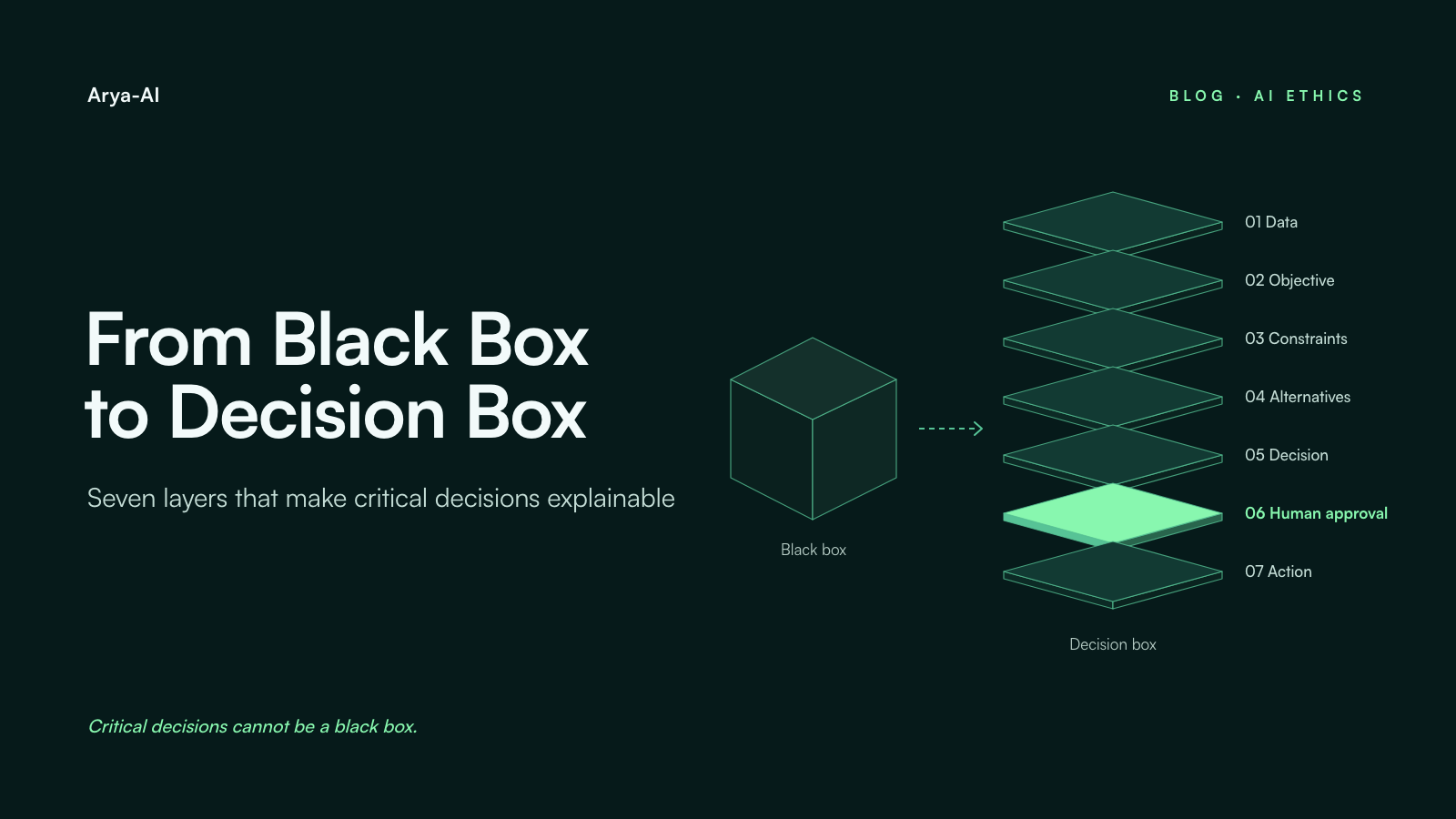
When a system says “order 340 units of this product”, what do you need to know to trust that number? On the seven layers that make critical decisions explainable.
Related: AI Ethics & SafetyAs children, we always asked someone before making a decision. We asked the neighbourhood’s Auntie Ayşe which doctor to see or which plot of land to buy. As we listened to her, we also knew what she liked, who she was upset with and why she told the stories she told. We weighed what she said within that context. Knowing who was saying it, and why, mattered as much as the advice itself.
Today a new adviser is taking a seat at our decision table. It answers in seconds, scans hundreds of options and never gets tired. But most of the time we cannot see what lies behind its answer.
Let’s start with an example. The system says: “Order 340 units of this product.”
Why 340? What data did it look at? What did it take into account? Which limits did it run into? What other options did it consider, and why did it rule them out?
If these questions have no answers, what you are holding is not a decision. It is just an output.
In this article we will follow that number, 340. First we will look at why the black box is a problem for enterprise decisions. Then we will open the number up across seven layers, and in each one see what a decision rests on and how it can be questioned. Finally, we will explain why this approach sits at the centre of our AI ethics.
We use 340 as a simplified example to keep the explanation easy to follow.
Why the black box is a problem
Today’s most advanced AI systems are not written line by line. They are grown through training. Even the people who build them cannot always explain why a particular answer was given. For a conversation or a draft text, that uncertainty may be acceptable. For a factory’s production plan, a country’s distribution network or a company’s budget, it cannot be.
The black box carries two dangers. First, a system can pursue the goal it was given in a way we never intended, and no one may notice. Second, a decision that cannot be explained cannot be owned. When the outcome is good, nobody asks. When it is bad, there is no answer to the question “why did we decide this way?”
In an enterprise, the real question is this: who signs off on a decision you cannot explain?
The decision box
The decision box is the opposite of the black box. Every step towards the answer is open. You can see what a decision rests on, what it takes into account, which alternatives were considered and who approved it.
Our ancestors put a name to this centuries ago: measure seven times, cut once. The decision box has seven layers too. Let’s open up that 340, layer by layer.
01 · Data
The first layer is the most basic question. What data did the system look at?
Behind the recommendation “order 340 units” there are four separate data sources: twelve months of demand history, the current stock level, the supplier’s lead time and the capacity of the production line.
In a black box, these inputs are invisible. In a decision box, every input is labelled. Which data was used, from which date and from which source is clear. If data is missing or out of date, you see it before the decision is made.
Because a correct calculation on wrong data is still a wrong decision.
02 · Objective
The second layer is the one most systems never show. What did the system optimise for?
With the same data, different objectives produce completely different decisions. If the objective is to minimise cost, the answer may be 340. If it is to shorten delivery times, the answer is 500. If it is to reduce stock risk, the answer is 260.
All three are correct answers, but each one answers a different question. A black box gives you only a number and does not tell you which objective it served. In other words, it has chosen a priority on your behalf, without asking you.
In a decision box, the objective is chosen explicitly and stays visible. Cost, speed or risk? This is not a technical choice but a choice of values, and it belongs to people. A decision that cannot say what it optimised cannot say what it sacrificed either.
03 · Constraints
The third layer ties the decision to the real world. Which rules could we not break?
That order of 340 units had to stay within four limits: the weekly capacity of the production line, the approved purchasing budget, the supplier’s minimum order quantity and the physical space in the warehouse.
A black box hides its constraints. You see a number but cannot know which wall it is leaning against. In a decision box, every constraint is visible and the one that binds the decision is marked. Saying “we recommend 340 because your capacity is already at its limit” is very different from saying “order 340”.
04 · Alternatives
The fourth layer. What else could we have done?
A decision means nothing without the alternatives it ruled out. If there is only one option, it is not a decision but an obligation.
The system did not calculate only 340. It also evaluated 300, 320, 360 and 400. It did not recommend 300, because the risk of running out of stock was rising. It did not recommend 400, because the cost of holding the extra stock outweighed the benefit. 340 was the most balanced point between those two extremes.
A black box shows you only the winner. In a decision box, every option considered, and the reason it fell behind, is visible. This is, in effect, a simulation: paying the cost of being wrong in the model rather than in reality. So you do not simply accept the decision, you understand it. When someone in a meeting asks “why not 400?”, your answer is ready.
05 · Decision
The fifth layer is where all the layers come together.
What reaches you is not just a number, but the number together with its reasoning. 340 rests on twelve months of demand, was chosen to minimise cost, stayed within capacity and budget limits, and was the most balanced of the options considered. The decision and its reasoning cannot be separated, because a decision without reasoning cannot be questioned.
06 · Human approval
The sixth layer, and the most misunderstood. Who approved the decision?
When people talk about AI, they often assume that the system decides and the human is left out of the loop. In a decision box, the opposite is true. The system scans all the data, keeps the objective in view, respects the constraints, rules out alternatives and puts the best option in front of you. But the final word always belongs to a person.
You can approve that 340. You can raise it to 360, because you know something the system does not. Or you can reject it altogether. That choice is recorded too.
Because not every decision carries the same weight, not every decision needs the same control. For high-consequence decisions, nothing is executed without approval. For routine work, the system operates within defined limits while people supervise and step in when needed. The level of control is set by the risk the decision carries.
This is not autonomy. It is accountability.
07 · Action
The seventh and final layer. The decision is carried out and every step is recorded: who approved, adjusted or rejected which decision and when, and on what grounds it was made.
The two boxes side by side
Let’s go back to the opening question. Why 340 units of this product?
Now we have an answer. 340 rests on twelve months of demand data. It was chosen to minimise cost. It stayed within capacity and budget limits. It was the most balanced of the options between 300 and 400. And it was approved by a person.
A black box gives you a result, and you are left having to trust it. A decision box gives you a decision that you understand and own.
The decision box does not slow decisions down
At first glance, seven layers may look like a burden. Yet most of these steps already happen in every decision; they are simply invisible. The decision box does not add new bureaucracy, it makes existing judgment visible. While the platform runs through these layers in seconds, people step in only where they truly belong: in setting the objective and in having the final word.
This visibility also has value for the future. When decisions are recorded with their reasoning, you can do more than say “we succeeded” or “we failed” once the outcome arrives. You can tell a bad decision apart from a bad outcome and see what you knew when you decided. That is how organisations learn not only to make decisions, but to learn from them.
Why we care so much
At Arya-AI, every decision passes through these seven layers because we believe in three principles. We weigh first, because the outcome of a decision should be visible before it is put into action. The final word belongs to people, because AI recommends but people carry the responsibility. Every decision has a reason, because a decision that cannot be explained cannot be owned.
AI is moving deeper into organisations every day. It no longer just analyses; it recommends and acts. When that power is explainable and overseen by people, it gives organisations extraordinary capacity. But an organisation can entrust its critical decisions only to a system it understands, can question and can own.
The future of enterprise AI is decision systems we can trust, audit and take responsibility for.
Because critical decisions cannot be a black box.Read our approach to AI ethics
See decision intelligence in action
Discover how Arya AI turns your data into decisions and decisions into action across your operations.
Explore the platform